

Blog
Mounting Accessories on Polyethylene Boats: How to Install Consoles, Bimini Tops, and Motors?


Mounting accessories on polyethylene (HDPE) boats is a 100% waterproof maritime engineering process performed using extrusion plastic welding and threaded brass insert systems, completely eliminating the risk of hull penetration and leaks common in traditional fiberglass (FRP) boats. While water leaking through the screw holes of consoles or awnings added to fiberglass boats eventually causes internal rotting (osmosis), accessories on Zümrüt Marine’s HDPE boats are either fused at the molecular level with the main hull or secured with specially insulated stainless steel bolts. Produced in our Bursa-based manufacturing facility and shipped directly to individual consumers across all coasts of Turkey and internationally, our custom-built boats integrate all equipment directly from the factory—from the outboard motor transom to the chrome Bimini top mounts and steering console. We engineer these vessels with the ultimate goal of maximum safety and zero Total Cost of Ownership (TCO) for amateur sailors, families, and hobby fishermen.
Assembly Dynamics in HDPE Boats and the Difference from Fiberglass
The most common question individual sea enthusiasts have about polyethylene boats is: “Can you screw into a plastic boat, or can accessories be added later?” When you want to attach a console or a rod holder to a fiberglass (FRP) boat, you must drill through the gelcoat with a drill, insert the screw, and insulate it heavily with marine silicone. However, silicone dries and cracks under the sun over time, and the saltwater entering through that screw hole rots the internal fibers, spelling the end of your boat.
In Zümrüt Marine HDPE High-Density Polyethylene boats, the mounting logic is completely different and flawless. It is not recommended to drive sharp self-tapping screws directly into polyethylene material. Instead, using hot air extrusion welding technology, consoles or seating groups made from the exact same polyethylene raw material are melted (welded) directly onto the deck of the boat. For metal hardware that needs to be removable (chrome awning legs, cleats), watertight brass inserts (threaded sockets) are embedded into the hull during the production phase, or a through-bolting method is utilized, ensuring absolute isolation with a ± 0.05 mm measurement tolerance.
Request a free consultation today for your Zümrüt Marine boat, featuring customized equipment where you can safely set sail with your family.
How to Install the Steering Console and Seating Group?
The steering console is the brain of the boat. It houses the steering cable, throttle mechanism, and electrical wiring. In the custom boats we produce directly for individual users, console installation is carried out with the following technical steps:
- Monoblock Welding Integration: The steering console, specially CNC-cut and shaped from HDPE plates, is positioned on the boat’s deck. In expert hands, the boat’s floor and the console’s base are simultaneously heated to 200°C using a polyethylene welding gun, and a polyethylene wire is fed between them, fusing them into a single piece (monoblock). It becomes physically impossible for the console to break off from the boat.
- Routing of Wiring and Cables: The channels for the steering cable and electrical wires are routed through the double-wall (sandwich) hull, well above the waterline in a closed circuit (inside conduits). This prevents cable clutter on the deck and ensures the wiring does not oxidize in the event of water splashes.
- Modular Revision: If the user wishes to change the location of the console in the future, the welded area can be shaved down and smoothed, and the console can be re-welded to its new spot. Unlike fiberglass, there are absolutely no lingering holes, epoxy, or putty marks.
Stainless Steel Bimini Top and Railing Installation Stages
Bimini top systems, added to protect against the sun during the summer months, exert a serious lifting force (pulling load) on the hull due to wind while cruising. Therefore, the mounting of chrome awning legs and railings to the HDPE hull must be done using 316L grade stainless steel bolts.
On the Zümrüt Marine production line, the points where the awning or railings will be attached are predetermined. Thick HDPE backing plates are welded to the inner part of the hull to increase wall thickness. A hole is then drilled, and the bolt is tightened with a counter nut using special marine sealing gaskets (neoprene or polyurethane-based sealants). This flexible connection ensures that the chrome awning remains stable in windy conditions without damaging the boat, while completely eliminating any capillary cracks that might occur during flexing (thanks to the tensile strength of HDPE).
Outboard Motor Transom Connection
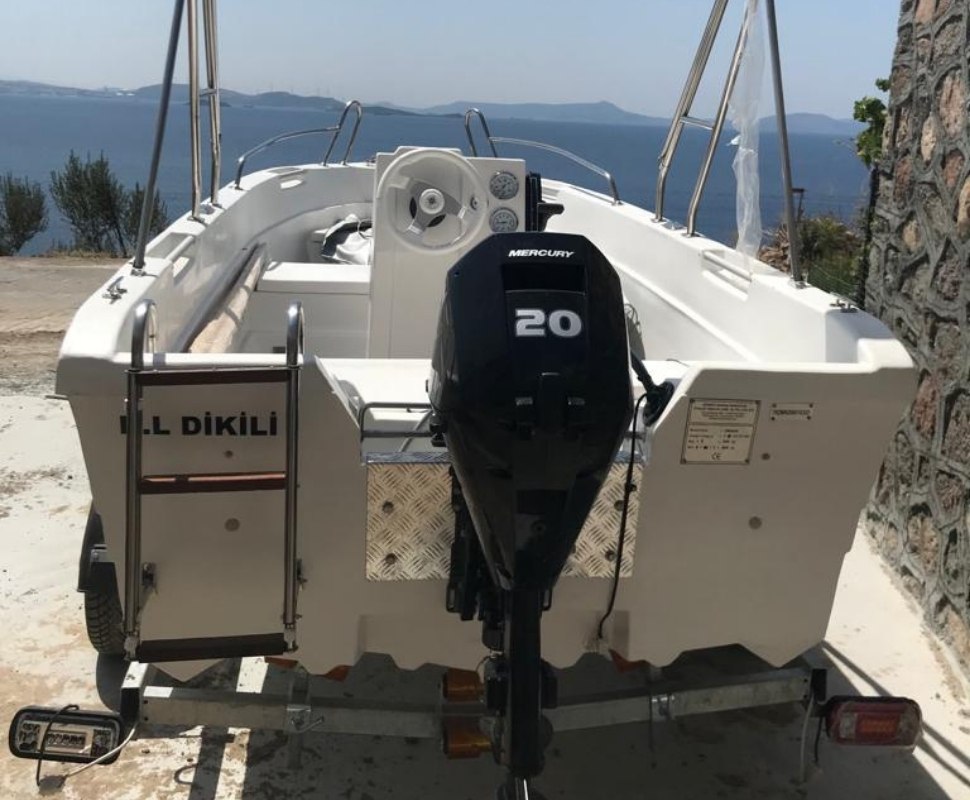
In personal hobby boats, the most critical area that transmits the engine’s power to the boat is the transom. As the engine’s propeller pushes the water, it applies a massive torsional force (torque) to the transom.
In Zümrüt Marine boats, the motor transom is created by welding reinforced HDPE plates ranging from 15mm to 20mm on top of each other, supported from the inside with special cross-support stringers. However, to prevent the outboard motor’s mounting clamps from crushing the HDPE surface, seawater-resistant aluminum or stainless steel plates are placed on both the inner and outer surfaces of the area where the motor will sit. The main mounting bolts of the engine pass through these metal plates, compressing the boat’s transom. This engineering ensures that even powerful outboard motors of 100 Horsepower (HP) and above are connected to the boat with 100% industrial performance and absolute safety.
B2C Equipment and Accessory Selection Guide: Zümrüt Marine Models
At Zümrüt Marine, we prepare the boats we offer to individual sailors and amateur fishermen with factory-fitted equipment (turnkey) according to their specific needs. (The table below serves as a guide for sailors who want to customize their boat to their own taste.)
| Accessory and Equipment Type | Mounting and Material Technology | Technical Purpose of Use | Benefit to User / TCO Impact |
|---|---|---|---|
| Jockey or Center Console | Monoblock Extrusion Welding (Screwless) | Steering, Throttle, and Trim Management | Cruising Comfort, Hole-Free Waterproofing |
| Foldable Chrome Bimini Top | 316L Stainless Bolt + Backing Plate | UV Protection, Wind/Rain Shield | Maximum Cruising Comfort for Family Use |
| Livewell and Underwater Lighting | Integrated HDPE Basin + Gasketed Pass-through | Keeping Live Bait, Night Fishing | Practicality in Hobby Fishing, Zero Water Leaks |
| Stainless Steel Cleats / Railings | Through-Bolt Connection | Boat Mooring and Deck Safety | Tear-Proof Flexible Infrastructure Under Heavy Loads |
Contact us today to build your dream Zümrüt Marine boat with your desired equipment and get a pricing quote.
Total Cost of Ownership (TCO) and Freedom of Customization
The aspect that strains the budget of individual boat owners the most is the surprise fiberglass/putty labor costs that arise when adding new equipment to the boat after purchase. Zümrüt Marine’s HDPE boat infrastructure offers incredible modularity for the equipment (radar arches, extra seats, swim platforms) you might want to add to your boat in the coming years.
The maintenance-free nature of polyethylene material (requiring no antifouling paint, no osmosis prevention, no waxing) also manifests itself in the accessories. Since an added console or seating group is made of the exact same material as the boat, it will not rot from the sun, suffer color separation, or degrade over time. This harmony brings the Total Cost of Ownership (TCO) close to zero for individual sailors, transforming the boat from an “expense trap” into a vehicle of pure enjoyment.
From Bursa to Turkey and the World: Zümrüt Marine Logistics Guarantee
Our Bursa factory, the center of quality in custom boat manufacturing, brings the best engineering solutions directly to the end-user (the amateur sailor). All our fully equipped boats featuring CE safety and marine quality certifications are shipped directly to hobby fishermen across Turkey—especially to the coastlines of Mudanya and Gemlik, as well as Istanbul, Izmir, Bodrum, Antalya, and the Black Sea region—as door-to-door (marina/dry-dock) deliveries via our truck or special trailer network. For our international individual customers, we carry the Zümrüt Marine quality into global waters by providing export-ready packaging and customs clearance support compliant with international transport standards.
Place your custom production order now for your family’s Bursa-manufactured, high-quality, and fully equipped polyethylene boat.
Frequently Asked Questions
1. Can I screw in a rod holder or cup holder myself later on a polyethylene (HDPE) boat?
Yes, but sharp-pointed wood/metal screws do not hold well in polyethylene. The safest method is to prefer coarse-threaded plastic screws or through-bolt systems where you can use a nut on the opposite side. Care must be taken not to drill holes below the waterline.
2. Can the boat’s outboard motor transom withstand the weight and torque of large engines?
Absolutely. The motor transom of Zümrüt Marine boats is reinforced with inner and outer support stringers reaching a wall thickness of up to 20mm and compressed with stainless steel plates. Our boats safely and rigidly carry outboard motors up to the maximum HP (Horsepower) designated for their design category.
3. Do I need to send my boat back to the factory if I want to add a Bimini top later?
No. You or your local marine mechanic can easily install the chrome legs for the awning mechanisms on the gunwales (upper edges) of your boat using the through-bolt method. Polyethylene does not crack or shatter like fiberglass when drilled.
4. Will the steering console on Zümrüt Marine boats let water in? Are the cables inside safe?
Because the console is molecularly welded to the boat’s floor with a hot air extrusion welder, not even a microscopic gap remains between the floor and the console. Therefore, when the deck is washed or a wave hits, it is physically impossible for water to seep into the console from below; your electrical wiring is perfectly safe.
5. How does the boat I ordered from your factory in Bursa reach the city I live in?
After your boat is professionally assembled in our factory with all the accessories you requested (console, livewell, awning), it is covered with protective packaging and delivered directly to the marina or your home in your city via our own logistics network or contracted trailer transport companies.